Yellow Isn’t Just a Color—It’s a Beacon.
Humans have a long and instinctive relationship with the color yellow. It appears in sunlight, ripe grain, autumn leaves, and early morning skies. Yellow often enters human awareness before words do, shaping how brightness, warmth, and attention are perceived.
Because it reflects more light than most colors, yellow naturally draws the eye and holds it. Across centuries, this visibility helped yellow gain layered meanings tied to awareness, intellect, caution, and vitality.
As societies evolved, yellow shifted roles. At times it symbolized honor and wisdom. In other moments, it carried warnings or social boundaries.
These contrasting roles make yellow one of the most complex colors to interpret. Its presence rarely feels neutral. Instead, it signals that something deserves notice, whether physical, emotional, or symbolic.
Key takeaways
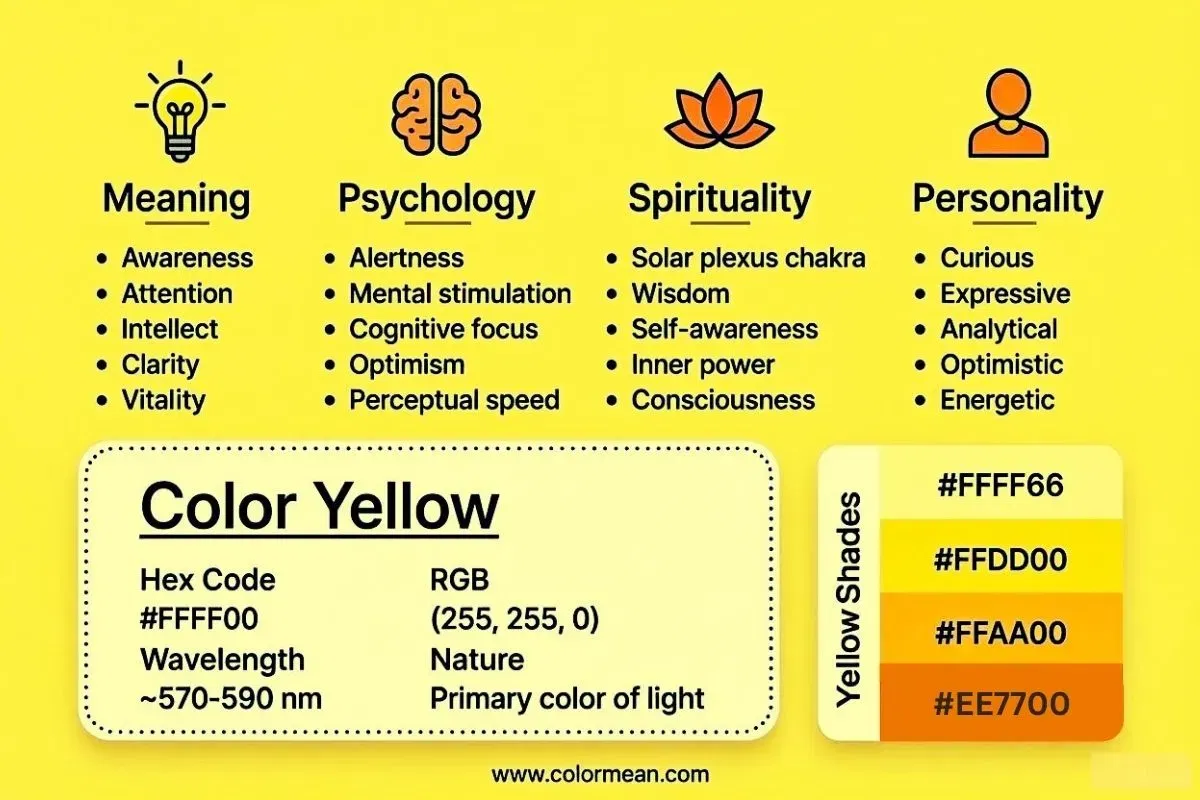
- Yellow is uniquely visible, making it a universal signal for attention and mental alertness.
- It has served as a dual symbol of both royal authority and common caution.
- Spiritually, yellow is tied to the intellect and self-identity, represented in the solar plexus chakra and certain crystals.
- Psychologically, it stimulates cognitive function, sharpening memory and perception over emotion.
- While its meanings vary across cultures, yellow consistently represents clarity, value, and significance.
What is color yellow?
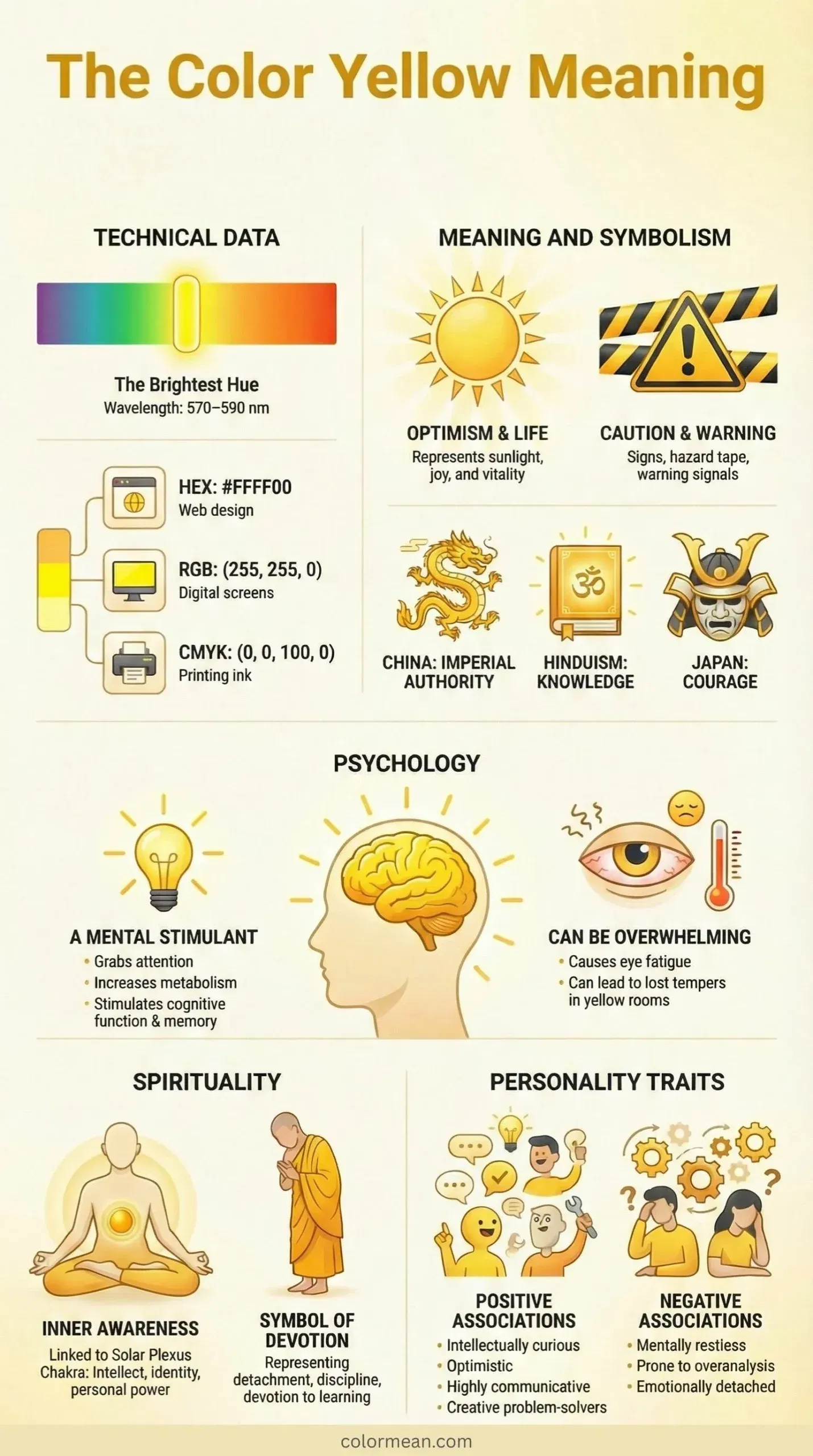
Yellow is a primary color positioned between green and orange on the visible spectrum. Its wavelength measures approximately 570–590 nanometers. Scientifically, it is often described as the brightest hue perceptible to the human eye. Consequently, this brightness makes it closely associated with light, clarity, and heightened perception.
In color science, pure yellow is created by stimulating both the red and green cone cells in our eyes nearly equally. Unlike cooler colors, yellow advances visually and captures attention rapidly. This makes it a powerful tool for signaling and communication in both nature and design.
To reproduce yellow accurately in digital and print media, designers use specific color codes:
- Hex Code: #FFFF00
- RGB Code: (255, 255, 0) – This combines 100% red and 100% green light for digital screens, creating maximum brightness.
- CMYK Code: (0, 0, 100, 0) – This uses 100% yellow ink for print materials, requiring careful balance to maintain vividness.
However, yellow is far from a single note. From the sharp, green-tinted Lemon yellow to the warm, earthy Mustard, its popular shades each convey a distinct mood. The spectrum continues with the rich Golden yellow and the fiery Amber, proving its incredible versatility.
History and interesting facts

History of the color yellow
Yellow pigments appeared very early in human history. Ancient people used yellow ochre, a naturally occurring clay rich in iron oxide. They used it to create artwork and ceremonial markings. Cave paintings across Europe and Africa feature these yellow tones.
In ancient Egypt, artists used yellow hues extensively. Gold was closely associated with the color. Consequently, they frequently painted gods and sacred objects using these pigments.
In China, specific shades of yellow were reserved for emperors. Based on traditional philosophy, only royalty could wear these shades. This practice elevated the color’s status significantly.
During medieval Europe, yellow had varied applications. While gold was widely used, duller yellow shades were also employed in certain contexts. These contrasts shaped the color’s complex reception.
The search for brighter, more stable yellows continued. In the 18th century, chrome yellow was discovered. This was a vibrant but toxic lead-based pigment. Later, in the 19th century, cadmium yellow was developed. It offered excellent opacity and lightfastness.
Modern synthetic organic pigments eventually replaced many toxic versions. Today, yellows are derived from advanced chemistry. They are crucial for everything from industrial paints to digital screens.
Interesting facts about the color yellow
- Yellow is one of the first colors the human eye detects at a distance.
- School buses and hazard signs use yellow because it remains visible in low light.
- In ancient manuscripts, yellow ink highlighted important passages.
- Bees are naturally attracted to yellow flowers due to high contrast visibility.
- Many national flags include yellow to represent wealth, sunlight, or hope.
Symbolism and representation
Yellow often symbolizes light, awareness, and mental activity. Its connection to the sun gives it associations with life, renewal, and growth. In symbolic systems, yellow frequently represents knowledge and learning rather than emotion or instinct.
At the same time, yellow represents caution. Its use in warning signs, traffic signals, and safety markings reflects its ability to communicate urgency without aggression. This dual role allows yellow to balance optimism with alertness.
In art and design, yellow can suggest openness and honesty. Bright yellow shades often feel expressive and outward-facing, while muted yellows suggest age, memory, or tradition. The symbolic meaning shifts with tone, yet visibility remains constant.
Meaning of the yellow color in spirituality

In spiritual traditions, yellow is strongly linked to the solar plexus chakra, which governs intellect, identity, and personal awareness. This energy center is associated with clarity of thought and internal strength. Yellow’s brightness mirrors these qualities, making it a symbolic color of consciousness.
Yellow auras are often described as indicators of mental energy and curiosity. They are associated with analytical thinking, creativity, and communication. Unlike colors tied to emotion or intuition, yellow aura interpretations focus on cognition and perception.
In spiritual practices, yellow appears in robes, candles, and symbols connected to wisdom and discipline. Buddhist monks often wear saffron or yellow robes to represent devotion to learning and detachment from material excess.
Yellow crystals are commonly used in spiritual settings that emphasize clarity, focus, and energetic balance.
Yellow crystals and their spiritual associations
| Crystal | Common Uses | Spiritual Meaning |
|---|---|---|
| 1. Citrine | Meditation and focus practices | Mental clarity and confidence |
| 2. Yellow Jasper | Grounding rituals | Emotional balance and stability |
| 3. Tiger’s Eye | Energy alignment | Inner strength and awareness |
| 4. Amber | Protective symbolism | Preservation of personal energy |
Psychological meaning of color yellow

Yellow has a powerful psychological effect due to its brightness and visibility. It stimulates the brain and increases alertness. This effect explains why yellow often appears in learning environments, signage, and communication tools.
Psychologically, yellow is associated with curiosity, mental engagement, and responsiveness. It can encourage attention and memory retention in small amounts. However, prolonged exposure to intense yellow shades may lead to restlessness or irritation, as the brain processes the color rapidly.
Yellow also influences perception. It can make spaces feel more open and energetic, yet too much yellow may overwhelm the senses. This balance makes yellow psychologically active rather than calming.
Color yellow personality traits

People commonly associated with the color yellow are often described through mental, communicative, and perceptive traits. These traits focus more on thought patterns than emotional intensity.
Positive traits
1) Intellectual curiosity
Yellow-linked personalities are often drawn to ideas, learning, and observation. They tend to notice details quickly and process information at a fast pace.
2) Optimism rooted in thinking
This optimism is usually mental rather than emotional. It reflects hope formed through reasoning, expectation, and anticipation of outcomes.
3) Strong communication skills
Yellow is closely tied to expression. Individuals aligned with this color are often verbal, articulate, and comfortable sharing thoughts or concepts.
4) Creativity through analysis
Creative ability connected to yellow often shows up in problem-solving, planning, and idea-building rather than artistic emotion alone.
Negative traits
1) Mental restlessness
Constant stimulation can make it difficult to slow down thoughts. This may appear as impatience or difficulty remaining still.
2) Overanalysis
A tendency to think deeply can turn into excessive questioning or mental looping, especially during uncertain situations.
3) Emotional detachment
Because yellow focuses on logic and awareness, emotional depth may feel secondary, creating distance in personal connections.
4) Sensitivity to mental pressure
Criticism or intellectual challenge may feel intense, as self-worth is often tied to ideas and perception.
What does the Bible say about color yellow?

The Bible does not frequently reference yellow by name, yet it consistently uses imagery connected to gold, light, brightness, and radiance, all of which align with yellow symbolism. These elements are used to represent value, wisdom, holiness, and divine presence.
Gold appears throughout the Old Testament as a sacred material. In Exodus 25:11, God instructs Moses to overlay the Ark of the Covenant with pure gold, reflecting holiness and reverence. This association links yellow-toned imagery with sanctity and divine order.
Wisdom literature often compares understanding to gold. Proverbs 16:16 states that gaining wisdom is better than acquiring gold, connecting yellow symbolism to intellect and discernment rather than wealth alone.
In the New Testament, light imagery plays a central role. Revelation 21:18 describes the New Jerusalem as shining with pure gold, clear as glass. This radiance emphasizes clarity, purity, and divine illumination.
Biblical yellow symbolism centers on enlightenment, sacred value, and spiritual clarity rather than emotion or warning.
Cultural and religious significance of the yellow color

Across cultures, yellow carries layered meanings, shaped by history, belief systems, and lived experience.
To begin with, in Chinese culture, yellow symbolizes imperial authority, balance, and earth energy. Historically, it was reserved for emperors, marking power and stability. In traditional philosophy, yellow represented the center, reinforcing its role as a symbol of cosmic order and grounded leadership.
Similarly, in Hinduism, yellow is deeply connected to knowledge, learning, and spiritual growth. Deities associated with wisdom, including Vishnu and Saraswati, are often shown wearing yellow garments. As a result, the color frequently appears in religious festivals, academic rituals, and sacred ceremonies tied to learning and clarity.
Moving into Buddhist traditions, yellow and saffron tones represent renunciation, discipline, and devotion to spiritual study. Monastic robes reflect simplicity and inner focus, shifting attention away from material status and toward mental awareness and ethical living.
In contrast, Japanese culture has linked yellow with courage and refinement. During certain historical periods, it symbolized bravery and noble character, often connected to warriors and elevated social values rather than spiritual withdrawal.
Meanwhile, in Western traditions, yellow holds more complex meanings. On one hand, it symbolizes happiness, warmth, and optimism. On the other, it has also been used to signal caution, warning, or even dishonesty, depending on the era, context, and shade used.
Finally, within African symbolism, yellow often represents fertility, prosperity, and spiritual energy. It appears widely in textiles, ceremonial art, and traditional designs, reflecting abundance, life force, and connection to ancestral wisdom.
Dream interpretations of color yellow

Yellow appearing in dreams often points toward mental states, awareness, or perception rather than physical action. The surrounding context shapes interpretation.
1. Seeing a bright yellow light
This scenario often reflects realization or heightened awareness. It may symbolize recognition of information that was previously overlooked.
2. Wearing yellow clothing
Dreaming of wearing yellow can relate to self-expression or intellectual confidence. It often reflects how ideas or opinions are presented.
3. Yellow objects standing out strongly
When yellow dominates a dream scene, it may indicate focus on a specific thought, idea, or concern demanding attention.
4. Faded or dull yellow environments
Muted yellow tones can symbolize mental fatigue, confusion, or difficulty maintaining clarity.
5. Yellow mixed with darker colors
This contrast often reflects tension between awareness and uncertainty. It may point to competing thoughts rather than emotional conflict.
How to use the color yellow
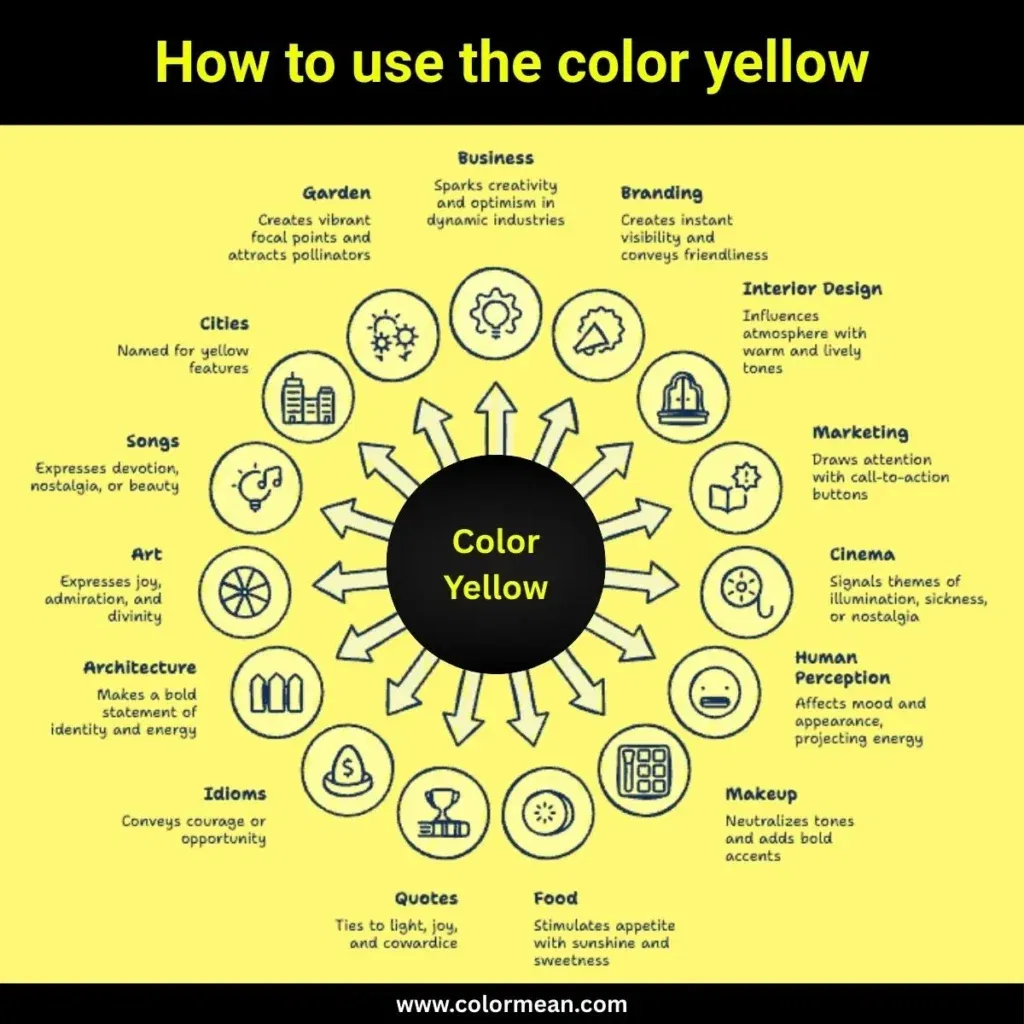
Yellow commands attention. Use it to spotlight, energize, and communicate. In small doses, it creates points of high interest and clarity. In larger amounts, it can define a space or brand’s entire mood. However, balance is key because too much bright yellow can feel overwhelming.
1) Color yellow in business
In business, yellow sparks creativity and optimism. It is often used in dynamic, forward-thinking industries. For example, a creative agency might use yellow in its office to stimulate innovative thinking. Alternatively, a technology startup could use yellow accents in its logo to suggest clarity and a fresh approach to solving problems.
2) Color yellow in branding
Yellow in branding acts as a visual shout. It creates instant visibility and conveys friendliness. The fast-food chain McDonald’s uses its golden arches for immediate recognition and to associate with happiness. Similarly, the shipping company DHL uses bold yellow to communicate speed, reliability, and high energy in its global delivery network.
3) Color yellow in interior design
In interiors, yellow influences atmosphere directly. A soft, buttery yellow in a kitchen can create a warm, welcoming, and sunny feeling all day. Meanwhile, a single accent wall in a bright mustard yellow can define a living room or study, making it feel more lively and intellectually stimulating. Yellow pillows or art are also common to add a quick burst of energy to a neutral space.
4) Yellow color in marketing
Marketing uses yellow for call-to-action buttons and sale tags because it draws the eye faster than most colors. It’s also effective for children’s products as it is associated with playfulness and joy. Furthermore, brands selling summer or leisure products often use yellow in visuals to evoke feelings of sunshine and happiness.
What does the yellow color mean in marketing?
In marketing, yellow primarily means clarity, optimism, and attention. It signals to the customer that something is positive, visible, and often innovative. However, its meaning can shift with shade. Bright lemon yellow screams urgency and cost-effectiveness (think sale signs), while a deeper, golden yellow suggests lasting quality and warmth.
5) Yellow color in cinema
Film directors use yellow to signal specific themes. Often, it marks illumination, sickness, or nostalgia. In The Grand Budapest Hotel, a rich golden yellow palette creates a distinct, nostalgic world. Conversely, in many thrillers, a sickly yellow tint might be used in scenes to indicate decay, poison, or psychological unease.
6) Yellow Color In Humans
On humans, yellow affects perception. Studies suggest people may perceive rooms painted yellow as warmer. Wearing yellow clothing often makes a person appear more approachable, energetic, and confident. However, because it is so eye-catching, it can also project a need for attention or a non-conformist attitude.
7) Yellow color in makeup
In makeup, yellow is a corrector, not typically a main color. A yellow color corrector is applied under foundation to neutralize purple or blue tones, like dark circles under the eyes. For a bold look, a dash of yellow eyeliner on the lower lash line can make brown eyes pop and create a modern, artistic statement.
8) Yellow food
Yellow food is often associated with sunshine, sweetness, and summer freshness. It stimulates the appetite with promises of citrus energy or comforting richness. For example, a ripe lemon or mango immediately suggests vitamin C and a bright, tangy flavor. Conversely, foods like corn, egg yolks, and golden pastry convey warmth, nourishment, and homemade goodness.
9) Yellow color In quotes
Quotes using yellow often tie it to light, joy, and cowardice. For instance, “How wonderful yellow is. It stands for the sun.” from Vincent Van Gogh celebrates its radiant, life-giving quality. A more cautionary view is seen in the common phrase, “He has a yellow streak,” which uses the color as a direct metaphor for fear or a lack of courage.
10) Yellow color in idioms
Yellow appears in idioms with strong, direct meanings. The phrase “Yellow-bellied“ is a clear and old-fashioned accusation of someone being cowardly. To have a “yellow streak“ means the same. More positively, the idiom “Golden opportunity” uses yellow’s association with gold to describe a chance of great value and promise.
11) Yellow in architecture
In architecture, yellow makes a bold statement of identity and energy. Historically, colonial buildings in the Caribbean were painted bright yellow to reflect the sun and stand out vividly against the blue sky and sea. In modern cities, a facade painted in ochre or gold can make a single building a cheerful landmark, suggesting creativity and public engagement.
12) Yellow color in art
In art, yellow is the color of light source and emotional temperature. Vincent van Gogh’s “Sunflowers” uses vibrant yellows to express joy and admiration. Later, Pablo Picasso’s “Blue Period” was briefly followed by a more hopeful “Rose Period,” where warm yellows and pinks began to replace cool blues, signaling a shift in mood. Yellow can also symbolize divinity, as seen in the golden halos of religious iconography.
13) Songs with yellow in the title
Songs titled with yellow often express devotion, nostalgia, or simple beauty. The Beatles’ “Yellow Submarine” creates a whimsical, joyful, and surreal world. Conversely, Coldplay’s “Yellow” uses the color as a metaphor for unwavering love and brightness, singing, “Look at the stars, see how they shine for you.”
14) Cities with color names: Yellow
While not common, some places are named for yellow features. Yellowknife, the capital of Canada’s Northwest Territories, is named for the copper knives used by local Indigenous people, which had a yellowish hue. Yellow Springs, Ohio, gets its name from the yellowish iron-oxide deposits found around its natural springs.
15) The color yellow in the garden
In the garden, yellow creates vibrant focal points and attracts pollinators. Sunflowers and daffodils are classic choices that bring bold, cheerful blocks of color and symbolize summer and spring respectively. For continuous interest, the yellow foliage of plants like Golden Spirit smoke bush adds a luminous, sunlit effect even without flowers, brightening shady corners.
Technical information
Color Conversion
RGB Values & CMYK Values
Color Variations
Color Harmonies
CSS Examples
Final thoughts
Yellow occupies a unique position among colors because it operates primarily through the mind rather than emotion or instinct. Its brightness forces recognition, whether in ancient art, sacred symbolism, cultural traditions, or modern design. This constant visibility shaped yellow into a color connected with knowledge, power, caution, and perception.
Across spirituality, psychology, and belief systems, yellow continues to represent awareness and meaning. Its presence signals importance, drawing attention to ideas, values, and moments that demand clarity. Through history and symbolism, yellow remains a color that speaks loudly without sound, shaping how humans interpret light, thought, and significance.