Green Isn’t Just a Color—It’s a Lifeline.
Step outside. Breathe in. Look around. You will likely see green. It is on trees, grass, and leaves. Green does not shout for attention like red. It does not dazzle like gold. Instead, it whispers calm, balance, and renewal. It connects us to nature and healing. It represents quiet strength. In a noisy world, that whisper is very important.
This post explores the world of green. It is not just a pigment. It is a psychological trigger and a spiritual symbol. Also, it is a cultural icon and a design tool. You may choose a paint color or build a brand. You might decode a dream or study ancient symbols. Green has meaning for all of these.
Key takeaways
- Green is the color of balance and harmony. It is tied to nature, healing, and emotional stability.
- Spiritually, green represents growth and compassion. It is linked to the heart chakra. It bridges earthly and divine energies.
- Historically, green’s meaning has shifted. It was sacred in ancient Egypt. It was sometimes forbidden in medieval Europe. Today, it is a symbol of environmentalism.
- Psychologically, green reduces stress. It also boosts concentration. This makes it ideal for workplaces, hospitals, and schools.
- Culturally, green has varied meanings. It signifies prosperity in Islam. It represents jealousy in some English idioms. Context shapes its message.
What is the color green?
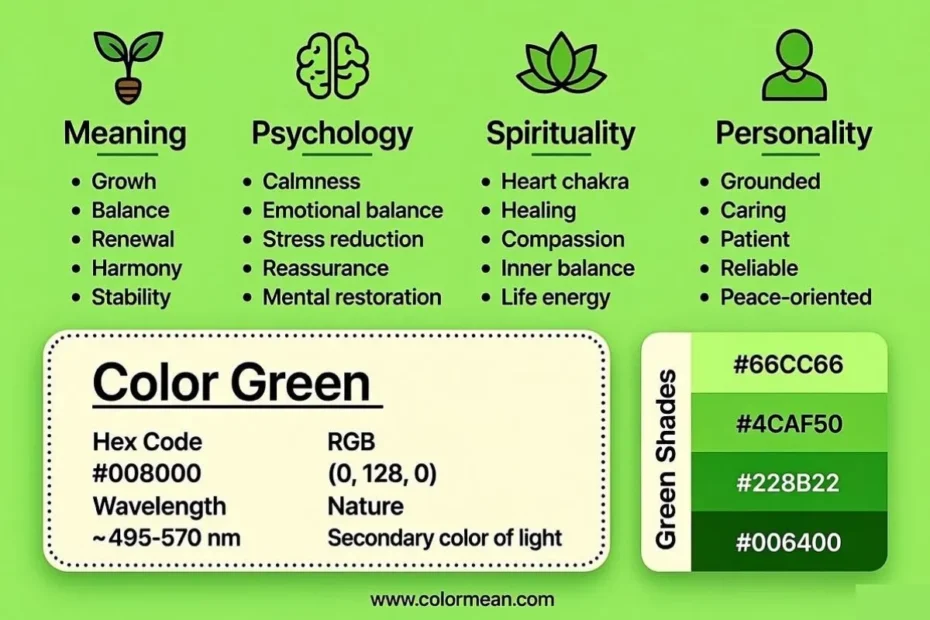
Green sits between blue and yellow on the visible light spectrum. Its wavelengths range from about 495 to 570 nanometers. It is the most visible color to the human eye. This explains why it dominates natural landscapes. Our eyes relax when we look at it.
Unlike red or purple, green belongs to everyone. It grows wild. It renews itself every season. And, it is the backdrop of life on Earth.
In traditional theory, green is a secondary color. It mixes blue and yellow pigments.
Designers use specific codes to reproduce green accurately:
- Hex Code: #008000
- RGB Code: (0, 255, 0) – for digital screens.
- CMYK Code: (100, 0, 100, 0) – for print materials.
Green has thousands of shades. From the luxurious Emerald and the wisely quiet Sage to the energetic Lime and fresh Mint, each shade carries its own distinct mood. Therefore, the right green can either soothe or stimulate.
Green appears abundantly in nature. Humans evolved to respond to it instinctively. We do not just like green. We need it.
Research shows that exposure to green spaces lowers cortisol. It also improves mood and sharpens focus. A 2018 study in International Journal of Environmental Health Research confirmed these restorative effects. This is biology meeting beauty.
History and interesting facts About Color Green
History
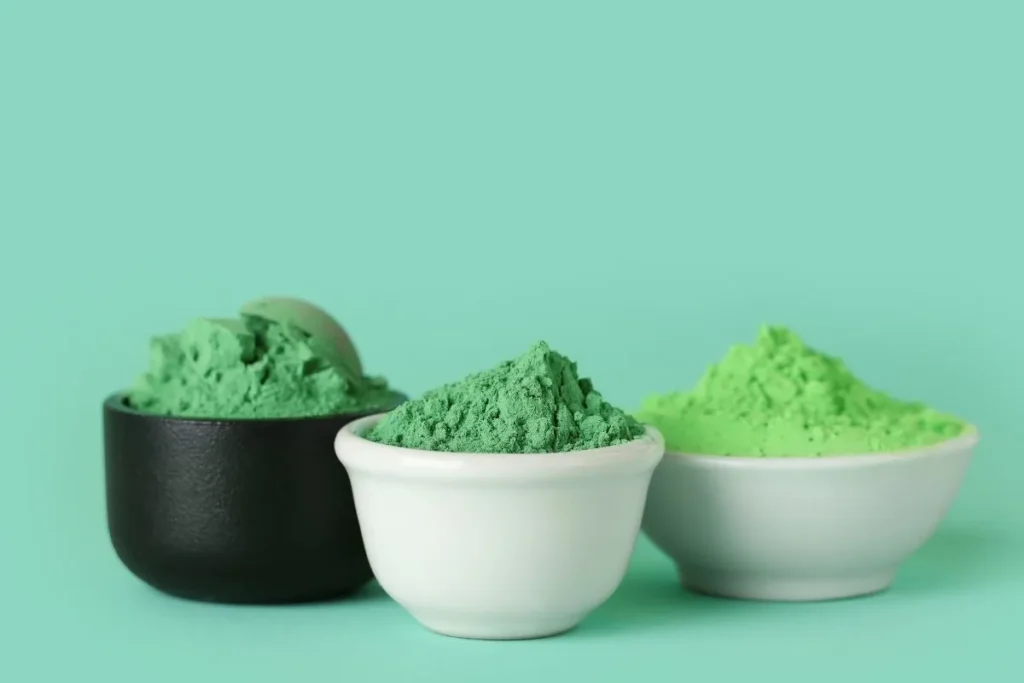
For centuries, making a stable green color was a major challenge. Early methods were unreliable. Egyptians used copper-based minerals like malachite or made synthetic green frit. Romans used green earth clay. For fabrics, dyers used double-dyeing with yellow and blue plants or verdigris from corroded copper. These greens often faded quickly.
The 18th century brought a toxic breakthrough. Chemists created Scheele’s Green and Paris Green. These were bright, popular, and arsenic-based. They were used in wallpaper, clothing, and paint. Research confirms they released poison dust, causing illness and death.
The search for safety led to modern pigments. In the 1800s, chromium oxide green and viridian offered stable, non-toxic options. Today, synthetic phthalocyanine greens provide the brilliant, permanent color we use everywhere.
Interesting facts
- Human eyes are most sensitive to green light. We detect over 10 million shades of green. This is likely due to evolution favoring survival in forested environments.
- Green is the rarest natural eye color. Only about 2% of the global population has green eyes. It is caused by low melanin and Rayleigh scattering.
- Ancient Romans used green as a status symbol. Emperor Nero reportedly watched gladiator fights through an emerald.
- Green was once banned on stage. In 19th-century theater, green costumes were avoided. They were dyed with toxic arsenic compounds that harmed actors.
- Plants are green because of chlorophyll. However, chlorophyll does not absorb green light well. Plants reflect it. The most abundant life-sustaining pigment rejects the color it displays.
- The word “green” comes from Old English. It shares roots with the word for “to grow.”
Symbolism and representation of green
Green is a master of duality. It stands for life and decay. It represents wealth and envy. At its core, green symbolizes growth and renewal. It is a universal emblem for personal development and seasonal cycles.
The color green also represents balance. On the color wheel, it sits between warm and cool colors. In design, green creates equilibrium.
In economic terms, green means prosperity. U.S. dollars are green. Yet it also represents envy.
Spiritually, green is linked to healing. Hospitals use soft greens to promote recovery.
Ecologically, green symbolizes environmental responsibility. It is the banner for protecting Earth’s resources.
Yet green can also warn of danger. Traffic lights use green for “go.” But toxic waste signs use it to signal contamination.
Meaning of the color green in spirituality
In spiritual traditions worldwide, green connects earth and sky. It links the body and soul. It also bridges action and reflection. This color anchors divine energy in the physical world. Simultaneously, it opens the heart to compassion.
Hinduism and Yoga
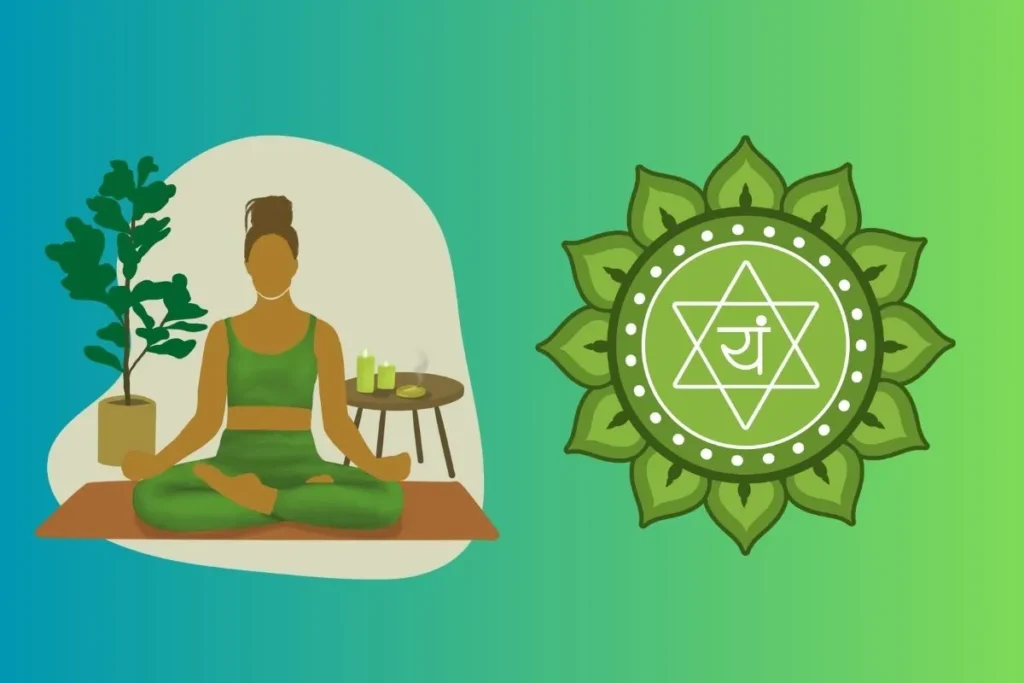
In Hinduism and Yoga, green rules the Heart Chakra, or Anahata. This energy center sits at the chest. It embodies love, empathy, forgiveness, and connection. A balanced heart chakra is said to radiate green light. This fosters relationship harmony and inner peace. Blockages may cause isolation or emotional numbness. Practitioners often use green crystals like jade. Meditation on emerald light is also common.
Islamic Tradition
Islamic spirituality highly values green. The Quran describes paradise with green cushions and lush gardens. Prophet Muhammad reportedly favored green garments. Many Islamic flags, like those of Saudi Arabia and Pakistan, feature this color. It symbolizes faith, fertility, and divine blessing. Green turbans often denote descendants of the Prophet.
Celtic and Druidic Beliefs
In Celtic traditions, green is sacred to nature spirits. The “Green Man” is carved into medieval churches. He represents the cyclical death and rebirth of plants. This extends to the soul’s journey. Wearing green was thought to invite faerie protection. However, overuse was believed to cause anger. This led to superstitions about green clothing bringing bad luck.
Buddhism
Buddhism associates green with balance and active compassion. The bodhisattva Green Tara is a swift protector. She removes fear and obstacles. Her green color signifies her readiness for merciful action.
Christian Mysticism
In Christian mysticism, green appears during “Ordinary Time”. This is the liturgical season between major feasts. It symbolizes spiritual growth, hope, and the ongoing faith journey. It is the color of waiting, learning, and becoming.
Psychological meaning of the color green

Psychologically, green acts as nature’s sedative. Environmental psychology research shows green spaces reduce stress hormones. They also lower blood pressure and improve cognitive function. Office workers with tree views report higher job satisfaction. They also take fewer sick days. A 2015 study found students in green painted classrooms performed better on tests.
Evolution explains this. Humans spent 99% of history in natural settings. Our brains interpret green as safe, nourishing, and restorative. Unlike alert red or detached blue, green strikes a middle ground. It is calm yet engaged.
Green also enhances creativity and problem solving. A 2012 study in the Personality and Social Psychology Bulletin had revealing results. Participants exposed to green before a task generated more original ideas. They outperformed those shown white, gray, or red. Researchers suggest green primes the mind for growth oriented thinking.
In therapy, green helps alleviate anxiety and depression. Hospitals use sage or seafoam in waiting rooms. These tones reduce agitation without causing drowsiness. Unlike stark white, green feels alive but not overwhelming.
Not all greens have the same effect. Olive greens promote stability and maturity. Bright lime greens can energize but may cause eye strain. Dark forest greens convey sophistication. They can feel heavy in small spaces. Context matters as much as the color itself.
Green color personality traits

People who strongly identify with green often embody its core qualities: balance, nurturing, and practical idealism. They are rarely extreme. Instead, they seek harmony in thought, action, and relationships.
Positive traits
1) Compassionate: Green personalities care deeply about others’ well-being. They listen more than they speak and act to heal divisions.
2) Reliable: You can count on them. They follow through, honor commitments, and avoid drama.
3) Growth-oriented: They believe in progress—personal, social, environmental. Stagnation frustrates them.
4) Peaceful: Conflict drains them. They mediate, compromise, and seek win-win outcomes.
5) Nature-connected: Many feel most at ease outdoors. They recycle, garden, or advocate for sustainability out of conviction, not trend.
Negative traits
1) Overly accommodating: In trying to keep peace, they may suppress their own needs, leading to resentment.
2) Passive-aggressive: When upset, they might withdraw or give the silent treatment instead of confronting issues directly.
3) Risk-averse: Their love of stability can turn into resistance to change, even when change is necessary.
4) Judgmental about ethics: They may look down on those they see as “harming the planet” or “lacking values,” forgetting nuance.
5) Emotionally guarded: While caring, they sometimes struggle to express deep vulnerability, fearing imbalance or burdening others.
What the Bible says about the color green
The Bible mentions green over 50 times. It consistently links the color to life, abundance, and divine blessing. Unlike symbolic colors like purple, green appears mostly in agricultural contexts. These references carry deep spiritual weight.
Psalm 23:2 states, “He makes me lie down in green pastures.” This signifies God’s provision, rest, and care. The image evokes safety and renewal.
Psalm 92:14 declares, “They will still bear fruit in old age, they will stay fresh and green.” This promises spiritual vitality for those rooted in God.
Green also signals covenant faithfulness. In Genesis, God sets a rainbow after the flood as a promise. The presence of green in the spectrum underscores restoration.
However, green is not always positive. Job 15:32 warns, “his branch will not be green.” A withered branch symbolizes judgment or unfruitfulness.
Jeremiah 17:8 contrasts the blessed person, “whose leaf stays green,” with the cursed. In Revelation, an emerald rainbow surrounds God’s throne, suggesting eternal vitality.
Cultural and religious significance of green

Green’s meaning shifts dramatically across borders. Culture deeply shapes color perception.
- In Islam, green is sacred. It represents paradise and the Prophet Muhammad. Many mosques feature green domes.
- In Ireland, green is national identity. The “Emerald Isle” nickname comes from its landscape. On St. Patrick’s Day, wearing green honors Irish heritage.
- In China, green symbolizes harmony and prosperity. However, a green hat implies a man’s wife is unfaithful. Context is everything.
- In Japan, green is tied to eternal life. Traditional gardens use moss to evoke tranquility. Historically, the same word was used for both blue and green.
- In India, green stands for new beginnings and harvest. It is prominent in festivals like Eid. Some brides wear green saris for fertility.
- In Ancient Egypt, green meant fertility and resurrection. Amulets of the green god Osiris were buried to ensure rebirth.
- In Mexico, green corn represents sustenance. The Aztecs associated it with Quetzalcoatl, the god of life.
- In Brazil, green on the flag symbolizes the nation’s vast forests. It is a source of national pride.
- In Nigeria, green signifies peace and healing. Traditional healers often wear green robes.
- In Indonesia, green is linked to Islam but also appears in Hindu ceremonies as a symbol of balance.
- In Scotland, clan tartans often feature green to represent local landscapes.
- In the United States, green means money and the environment. It also signifies inexperience or jealousy, a concept from Shakespeare’s Othello.
Dream interpretations of the color green

When green appears in dreams, it rarely signals danger. Typically, it reflects inner growth, healing, or a call to reconnect with nature. According to a study in Psychology of Aesthetics, Creativity, and the Arts, the color green is frequently associated with calmness and positive mood states.
Dream about Lush green landscapes like forests or gardens often indicate emotional renewal and peace. If you are stressed, this dream may be a subconscious prompt to rest. These scenes can also symbolize readiness for new life phases.
Rapidly growing green plants in a dream usually suggest personal development or creativity. For instance, they can represent a project finally bearing fruit. This imagery ties to concepts of natural progression and vitality.
Conversely, dream about sickly or yellowing green can point to neglected health. It may also symbolize fading relationships. Furthermore, this imagery can reflect ignored environmental concerns in your waking life.
Wearing green clothing in a dream might mean you are embracing compassion. Alternatively, it can show a desire for harmony in a current conflict. This aligns with color psychology research linking green to empathy and balance.
Green eyes in dreams often symbolize intuition or mystery. They may represent a person, or a part of yourself, that perceives deeper truths. This symbol encourages looking beyond surface appearances.
Artificial green, like neon or plastic, may warn of inauthenticity. It suggests something in your life appears natural but is not genuine. This serves as a cue to evaluate your surroundings for sincerity.
How to use the color green
1. Green in business
Green builds trust. Companies in health, finance and sustainability use it to signal reliability. It also represents growth and ethical values. For instance, Starbucks, Whole Foods and Spotify all feature green logos intentionally. Their choice communicates care for consumer well-being and the planet.
Furthermore, green can improve corporate communication. Using green accents in reports or presentations makes data feel less intimidating. This approach can make information appear more solution oriented.
2. Green in branding and marketing
Green conveys naturalness, safety or innovation. Organic products often use sage or olive green to suggest authenticity. Meanwhile, tech startups may select mint or teal to appear fresh yet professional.
However, context is critical. Marketers typically avoid bright greens in luxury sectors. While emerald is acceptable, lime can feel cheap. Research supports green’s effectiveness: studies show it boosts conversion rates for eco products. Consumers consistently associate this color with credibility.
3. Green in interior design
Green creates calm, focus and a connection to the outdoors. For example, sage bathrooms feel serene. Forest green libraries promote concentration.
Light greens, like seafoam, can make small rooms feel larger. Conversely, deep greens like hunter add sophistication to dining areas. Designers often pair green with wood tones, cream or soft gray for a grounded look.
Additionally, biophilic design relies on green. This practice brings nature indoors with plants, walls or textiles. Consequently, it reduces stress and improves indoor air quality according to environmental studies.
4. Green in cinema
Filmmakers use green to set precise moods. In The Matrix, a green tint reflects digital artificiality and surveillance. In The Wizard of Oz, the Emerald City symbolizes illusion.
Conversely, lush green forests in My Neighbor Totoro radiate safety and wonder. Generally, green lighting suggests rebirth, envy or the uncanny. Therefore, it is one of cinema’s most versatile emotional tools.
5. Green in humans
Genetically rare green eyes are a fascinating trait. Beyond that, green appears in health indicators. A greenish skin tint can signal illness like jaundice.
Yet “green” also describes vitality. The phrase “green living” ties the color directly to wellness choices. These choices include plant-based diets and mindfulness practices often supported by nutritional research.
6. Green in makeup
Green makeup is bold and strategic. For example, green eyeshadow enhances hazel or brown eyes through contrast. Color-correcting concealers use green to neutralize redness from acne.
This works because green is opposite red on the color wheel. While not mainstream for lips, green accents in editorial makeup signal avant-garde creativity on fashion runways.
7. Green food
Green foods like kale and avocado are marketed as superfoods. The color acts as a powerful health cue. Interestingly, people rate green smoothies as fresher than brown ones, even with identical ingredients.
Restaurants use green plates to make salads look more appetizing. However, context defines the meaning. Green meat triggers disgust, proving the color can mean either “healthy” or “spoiled.”
8. Green in quotes and idioms
Language reveals cultural attitudes. “Green light” means go. A “green thumb” signifies gardening skill.
In contrast, Shakespeare’s “green-eyed monster“ means jealousy. Other phrases like “green around the gills” describe nausea. These examples show green’s wide range from approval to inexperience.
9. Green in art and architecture
Artists use green to evoke mood. Monet layered greens to capture light in his water lilies. Van Gogh used swirling green to convey life’s turbulence in Wheatfield with Cypresses.
In architecture, green roofs and walls are functional. They reduce urban heat and lower building energy use according to environmental research. Historic sites like the Green Dome in Medina blend spiritual symbolism with visual serenity.
10. Songs with green in the title
Music uses green metaphorically. Coldplay’s “Green Eyes” ties the color to love. John Denver’s “Green, Green Grass of Home” equates it with nostalgia.
Kermit the Frog’s “Bein’ Green” turns the color into an anthem of self-acceptance. Essentially, these songs use green as emotional shorthand.
11. Cities named green
Few cities are literally named “Green,” but many embrace it symbolically. Greenville locations often highlight their parks and rivers. Greenbelt, Maryland was designed as a planned “green” community in the 1930s.
Similarly, Verde Valley in Arizona markets its landscape as a wellness destination. These places sell a lifestyle rooted in nature.
12. Green in the garden
A garden without green is unthinkable. Gardeners use variegated greens, like silver sage, to add texture. Green foliage provides the essential year-round structure for landscape design.
In Japanese Zen gardens, deep green moss creates meditative stillness. In cottage gardens, green vines soften edges. So, green is not just a background color in gardens. It is the very foundation of beauty.
Technical information about color green
Color Converter
Color Shades
Color Tints
RGB Percentage
CMYK Percentage
Color Harmonies
Complementary
Split Complementary
Analogous
Triadic
Tetradic
Monochromatic
Contrast Sensitivity
Summary:
The color #008000 has:
- 5.14:1 contrast ratio on white background
- 4.09:1 contrast ratio on black background
- Best readability on white background (5.14:1)
WCAG 2.1 Requirements:
| Text Size | AAA Requirement | AA Requirement | Status |
|---|---|---|---|
| Very Small (<14pt) | ≥ 7:1 | ≥ 4.5:1 | AAA AA |
| Small (14-18pt) | ≥ 4.5:1 | ≥ 3:1 | AAA AA |
| Large (>18pt) | ≥ 4.5:1 | ≥ 3:1 | AAA AA |
| Very Large (>24pt) | ≥ 3:1 | ≥ 3:1 | AAA AA |
Final thoughts
Green is the quiet heartbeat of our world. It does not flash like red. It does not command like black. Instead, it sustains and grows. Most importantly, it heals. From the chlorophyll in a leaf to a traffic signal, green moves life forward without fanfare.
Its power lies in balance. This is between wildness and order, abundance and restraint. Consequently, green appears everywhere in our culture. You find it in sacred texts and on hospital walls. It is on protest signs and smartphone icons. Essentially, it speaks a universal language of renewal.
Whether painting a bedroom or walking in a park, pay attention to green. It shows you more than what you see. It shows you how to live. This means living grounded, growing, and gently resilient.
Today, green offers more than aesthetics. We face a climate crisis, digital overload, and social fragmentation. In this context, green provides an essential anchor.
FAQs about the color green
Green represents growth, balance, and nature. It also symbolizes healing and renewal. Furthermore, it can mean prosperity, as with money. In some contexts, it signifies jealousy or inexperience.
Spiritually, green embodies compassion and harmony. It represents the heart’s energy. Importantly, it bridges the physical and spiritual realms. This encourages love and connection with all living things.
The Heart Chakra (Anahata) is linked to green. It is located in the center of the chest. This chakra governs love, empathy, and emotional balance. A healthy heart chakra radiates calm energy.
A green personality is compassionate and reliable. These individuals are peace-loving and value harmony. They also care deeply about people and the planet. Under stress, they may become passive.
In the Bible, green symbolizes life and divine blessing. For instance, “green pastures” represent God’s provision. Withered greenery signals judgment. Overall, green reflects spiritual vitality from faithfulness.
Green in dreams usually points to healing or personal growth. Lush greenery suggests emotional renewal. However, sickly green may warn of imbalance. Recurring green dreams often invite you to reconnect with nature.