
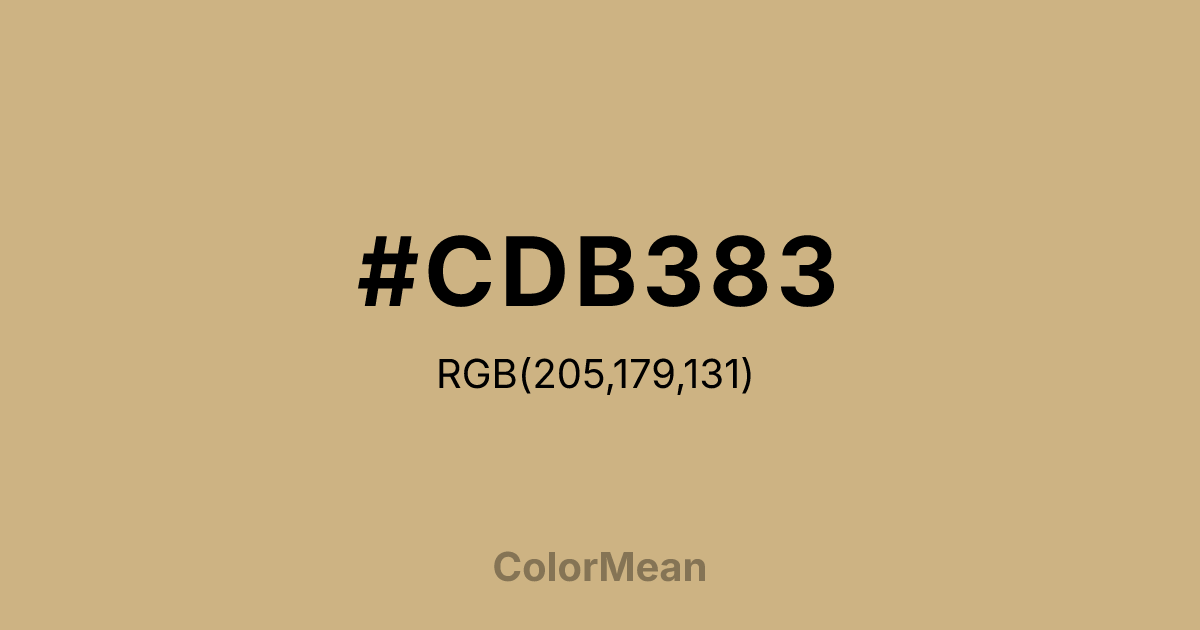
#CDB383 Color Information
#CDB383 RGB value is (205, 179, 131). The hex color red value is 205, green is 179, and blue is 131. Its HSL format shows a hue of 39°, saturation of 43 percent, and lightness of 66 percent. The CMYK process values are 0 percent, 13 percent, 36 percent, 20 percent.

#CDB383 Color Meaning
Color #CDB383 steps further into earth pigment territory, evoking weathered sandstone, unbleached linen, and desert twilight. Color #CDB383 serves as a bridge between neutral and warm brown, offering depth without heaviness. Its muted richness makes #CDB383 ideal for grounding palettes that reject both monochrome sterility and overt earthiness. Psychologically, color #CDB383 induces calm through familiarity. Humans are attuned to mid-tone earth hues from evolutionary exposure to soil, rock, and shelter. #CDB383 shade triggers a mild parasympathetic response—lowering heart rate slightly and encouraging presence. #CDB383’s particularly effective in wellness, hospitality, and residential design where “quiet luxury” is the goal. Historically, pigments like color #CDB383 were derived from natural clays rich in iron oxide. Their stability made them staples in frescoes, pottery, and early paints. Today, its digital form carries that legacy into sustainable design—where “warm neutrals” are coded as eco-conscious by virtue of their organic reference. But its power lies in restraint: #CDB383 never pretends to be bold. Design-wise, color #CDB383 excels as a base for layered textures. #CDB383 allows wood grains, woven fibers, and stone surfaces to shine because #CDB383 doesn’t compete. In branding, #CDB383 signals maturity—ideal for heritage labels, artisan goods, or services emphasizing craftsmanship over speed. #CDB383’s the color of slow attention.
Color Conversion
Convert #CDB383 across different color models and formats. These conversions help designers work seamlessly between digital and print media, ensuring this color maintains its intended appearance across RGB screens, CMYK printers, and HSL color manipulations.
RGB Values & CMYK Values
RGB Values
CMYK Values
Color Variations
#CDB383 harmonies come to life through carefully balanced shades, tints, and tones, giving this color depth and flexibility across light and dark variations. Shades add richness, tints bring an airy softness, and tones soften intensity, making it easy to pair in clean, modern palettes.
Color Harmonies
#CDB383 harmonies create beautiful relationships with other colors based on their position on the color wheel. Each harmony type offers unique design possibilities, enabling cohesive and visually appealing color schemes.
Analogous
Colors adjacent on the color wheel (30° apart)
Complementary
Colors opposite on the color wheel (180° apart)
Split Complementary
Three colors using one base hue and the two hues beside its opposite
Triadic
Three colors evenly spaced (120° apart)
Tetradic
Four colors forming a rectangle on the wheel
Square
Four colors evenly spaced (90° apart)
Double Split
Four colors formed from two base hues and the colors next to their opposites
Monochromatic
Variations of a single hue
Contrast Checker
(WCAG 2.1) Test #CDB383 for accessibility compliance against white and black backgrounds. Proper contrast ensures this color remains readable and usable for all audiences, meeting WCAG 2.1 standards for both normal and large text applications.
Sample Text
This is how your text will look with these colors.
Large Text (18pt+)
Normal Text
UI Components
Color Blindness Simulator
See how #CDB383 appears to people with different types of color vision deficiencies. These simulations help create more inclusive designs that consider how this color is perceived across various visual abilities.
Normal Vision
protanopia
Note: These simulations are approximations. Actual color vision deficiency varies by individual.
CSS Examples
Background Color
Text Color
Sample Text
Border Color
Box Shadow
Text Shadow
Sample Text
Gradient
#CDB383 Color FAQs
Frequently asked questions about #CDB383 color meaning, symbolism, and applications. Click on any question to expand detailed answers.